I Tore a 5,000 Yen Note in Japan — Here's How I Got It Back
I ripped a Japanese banknote in half mid-trip and panicked. Turns out Japan has a surprisingly civilised system for swapping damaged cash — here's exactly how it works, and what happened when I walked into a Fukuoka bank to test it.
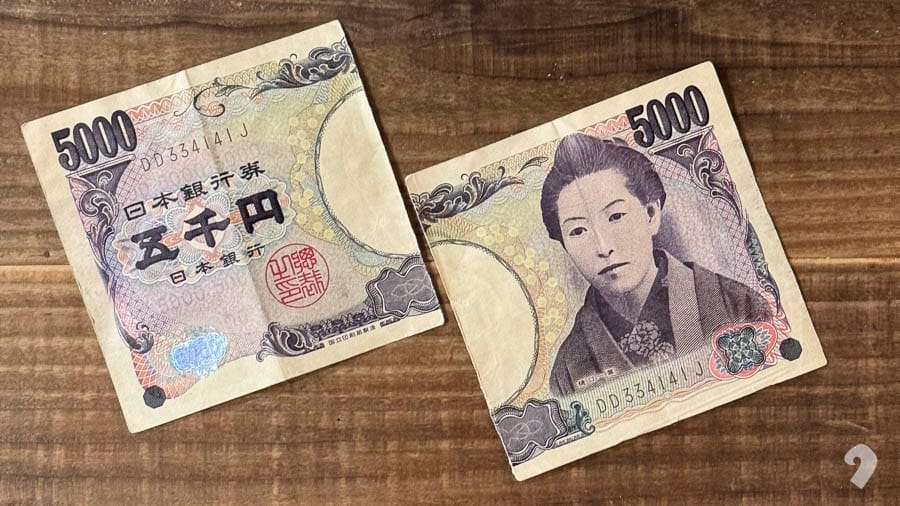
It happened mid-trip. I was rummaging through my bag in a hurry, grabbed what turned out to be an already-fragile banknote, and tore it clean in half. Cue an immediate spiral: what actually happens if you rip a yen note in Japan? Is the money just gone? I figured the only way to find out was to walk into a bank and try to swap it — and document the whole thing along the way.
How Japan handles damaged banknotes: it's all about surface area
Damaged cash in Japan is dealt with by the Bank of Japan (BOJ), and the rules are written into law. According to the BOJ's official guidelines on exchanging damaged currency, what you get back depends entirely on one thing: how much of the original note is left. It doesn't matter how badly torn or dirty it is — only the remaining surface area counts.
Full value
If both sides of the note are present and at least two-thirds of the original surface area remains, you can swap it for the full face value. 10,000 yen for 10,000 yen, 5,000 for 5,000. No fees.
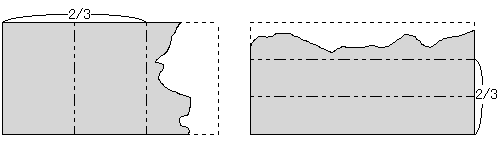
Half value
If between two-fifths and two-thirds of the note is left, you'll get back half the face value. So a ripped 10,000 yen note becomes 5,000 yen.
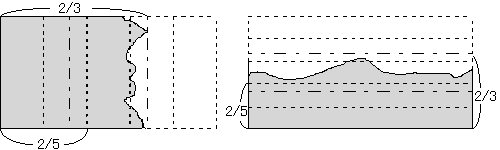
No value
Less than two-fifths remaining? The note is considered worthless and can't be exchanged.
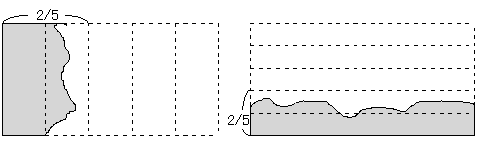
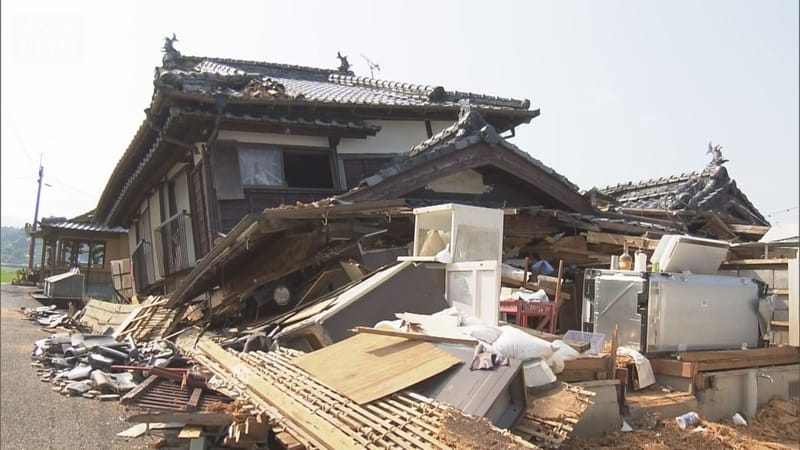
Because the whole system is based on surface area, even a note shredded into dozens of pieces can be redeemed at full value as long as you bring all the fragments and they can be reassembled. Astonishingly, even a banknote burned to ash can count — provided lab analysis confirms the residue came from currency. The BOJ specifically suggests using low-tack paper tape (like washi tape) to piece fragments back together, so staff can still read the serial number, design and colour to verify everything came from the same note.
Not every bank can help you
In theory, the big city banks (Sumitomo Mitsui, MUFG, Mizuho and so on), regional banks (Fukuoka Bank, Kumamoto Bank, etc.) and credit unions can all process damaged notes. In practice, it depends on the branch's size and how busy they are. Smaller branches have limited staff and cash on hand, and if a damaged note actually needs proper verification, they'll usually refer it to a larger branch or send it on to the BOJ. For seriously damaged notes that require detailed examination, the exchange may be processed as a deposit into an account rather than handed back as cash on the spot.
That said, the kind of accident most travellers run into — a torn note or two, still largely intact — doesn't need any of that. Even a small branch can usually sort it out on the spot. It's only the complicated cases that need the BOJ's head office or one of its 32 branches around the country, where the full damaged-currency exchange process is set up.
BOJ booking site: bojhikikae.rsvsys.jp (next month's appointments open on the 21st of each month)
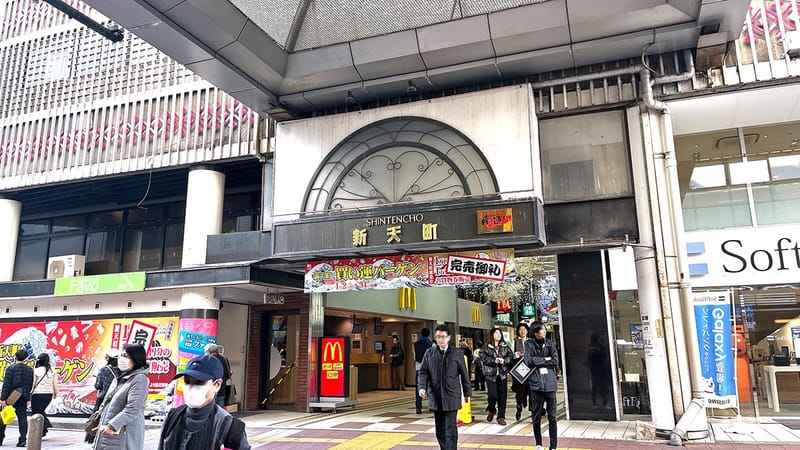
One thing worth flagging: Japan Post Bank (Yucho), which has by far the most branches in the country, does not offer banknote exchange. They'll only let you deposit the damaged note into an account — they won't swap it for a clean one. I learned this the hard way, walked out empty-handed, and ended up at a nearby Fukuoka Bank branch instead.
Worth knowing too: bank counters in Japan keep short hours. Most are open weekdays only, 9:00–11:30 in the morning and 12:30–3:00 in the afternoon, with an hour off for lunch in between.
Swapping a torn note at Fukuoka Bank, step by step
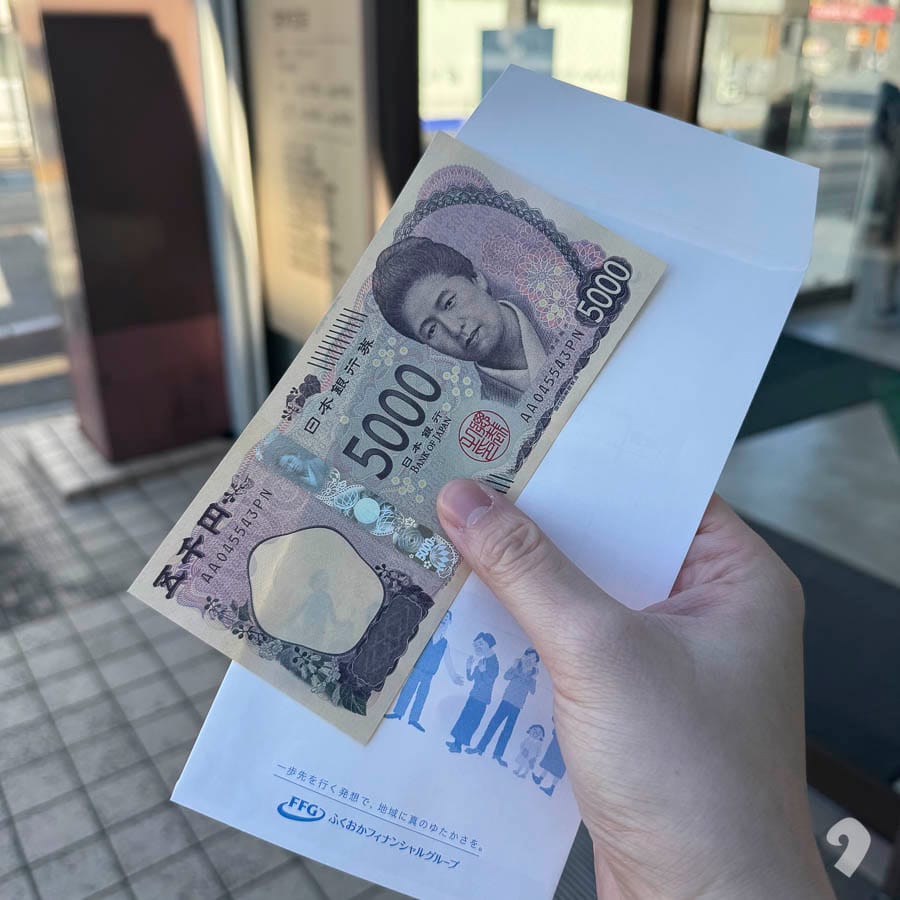
After my failed detour to Japan Post Bank, I walked over to the nearest Fukuoka Bank branch with my ripped 5,000 yen note.
Inside, I explained what I needed at the reception, took a number, and waited to be called. At the counter, the teller handed me a currency exchange form (両替・金種別票) — basic stuff: name, address, phone number and the amount I wanted to exchange.
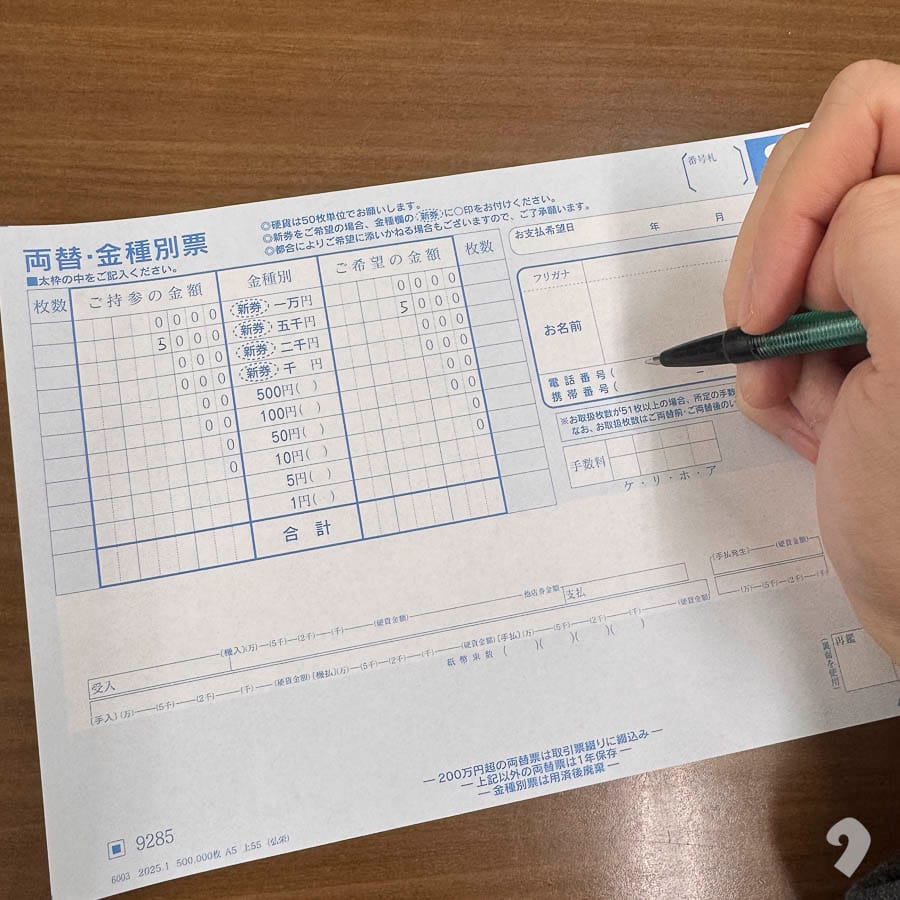
I handed the form and the torn note over, and a crisp new bill came back almost immediately. The whole thing took about 10 minutes, no fees, far easier than I'd expected. You don't really need Japanese either — the form is short, and staff are happy to help you through it.
Prepping a damaged note before you go
If your note is in pieces rather than just torn in two, a bit of prep work goes a long way toward getting the full value back. Here's what the BOJ recommends:
Torn notes: use low-tack paper tape (washi tape works perfectly) to piece the fragments back together, making sure both sides are visible. Don't use clear sticky tape or strong tape — it interferes with verification. If yours is a clean rip like mine, you don't really need to tape it at all.
Wet notes: separate them and air-dry one by one. Don't blast them with a hair dryer or try to iron them.
Burnt notes: leave them alone as much as possible and transport them in a box so they don't crumble further. Bring any ash along too — it can still be analysed and counted.
Dirty notes: a gentle rinse with water and air-drying is fine.
The single most important rule: bring every fragment, even the bits you couldn't tape back on. The bank calculates value based on the total area of pieces they can confirm came from the same note.
Useful info
What to bring
- The damaged note (and every fragment, no matter how small)
- ID (passport or residence card)
- A small box or pouch to keep fragments together
- If you booked an appointment, a printout or screenshot of the confirmation email
Tearing a banknote feels like a small disaster in the moment, but the exchange process itself is genuinely painless. As long as the fragments are reasonably complete, you'll almost always get the full value back. If it ever happens to you in Japan: keep every scrap, don't panic, and head to a bank — it's much smoother than you'd think.